As a millennial kid growing up in Sri Lanka, when the school took you on educational trips you were compelled to scribble something about the sites you saw on a notebook. It was mostly because our teachers made us. But, also we didn’t have mobile phones growing up until late into our teens, and certainly not a mobile phone as smart as a present day Samsung Galaxy or even an iPhone. That’s why they call us the digital pioneers, we adapted to a digital world.
Even though a millennial’s experience with all things digital isn’t as savvy as the Gen Z and Gen Alpha counterparts, digital devices now permeate our lives too. One glance into my Google Drive will show the thousands of travel photographs I’ve accumulated from information boards to sunrises, to cats on the street.
Since I arrived in South Korea last August, I have taken a few trips – Yeosu, Mokpo, Iksan and Gangneung. All of them quite adventurous, relaxing and stimulating. A couple of thousand photographs on my Samsung Galaxy will prove it. But no trip was as meaningful as my recent trip to Seoul. The only significant difference between all those trips and the Seoul trip; ZERO PHOTOS. It was an experiment in unmediated pleasure.
It all began with an itch to attend a music concert of singer and song writer Isaac Hong in Seoul. In the month between the ticket purchase and concert, I was reading Christine Rosen’s The Extinction of Experience: Being Human in a Disembodied World. The writing resonated with my recent habit formations to reduce technology use, inspiring me to wonder what a music concert, completely unmediated would yield. Before I left for Seoul, I set three conditions for the concert, first, no photographs, second, no videos and third, no social media from two days before the concert. None whatsoever. However, as I waited for the city bus to take me to the intercity bus terminal in Gwangju, a bunch of pretty wild flowers caught my attention and I stopped myself from clicking a picture of it. Eventually, the entire trip, two nights-three days, became the experiment.
I’ve boiled down my experiment to three parts. First, the experience at Gwanghwamun Sqaure, and particularly, the monument of Admiral Yi Sun-sun. Second, the original object of my trip to Seoul; the Isaac Hong concert. Third, the very real impact of saying 안녕하세요 (hello). This post is solely concerned with the first.
Immersing in the story of Admiral of Yi Sun-sin
Twenty-three (23) naval battles, twenty-three (23) he never lost. Admiral Yi Sun-sin (이순신 장군) undoubtedly the greatest warrior in Korean history, revered by many for his fearless pursuits during the Imjin War (임진왜란) is one of the highlights of the Gwanghwamun Square. A sculpture, larger than life, exuberating the Admiral’s valiance stands tall at the Square. On one side of the sculpture are tablets with inscriptions of the Admiral’s battleground feats. On the other side, a careful selection of the Admiral’s greatest words.
I took out my pocket notebook and proceeded to read and write the Korean names of each of the battles inscribed on the tablets. The battles were many and hard fought, but one victory after another. They were a true testament to the Admiral’s ability to formulate naval strategy.
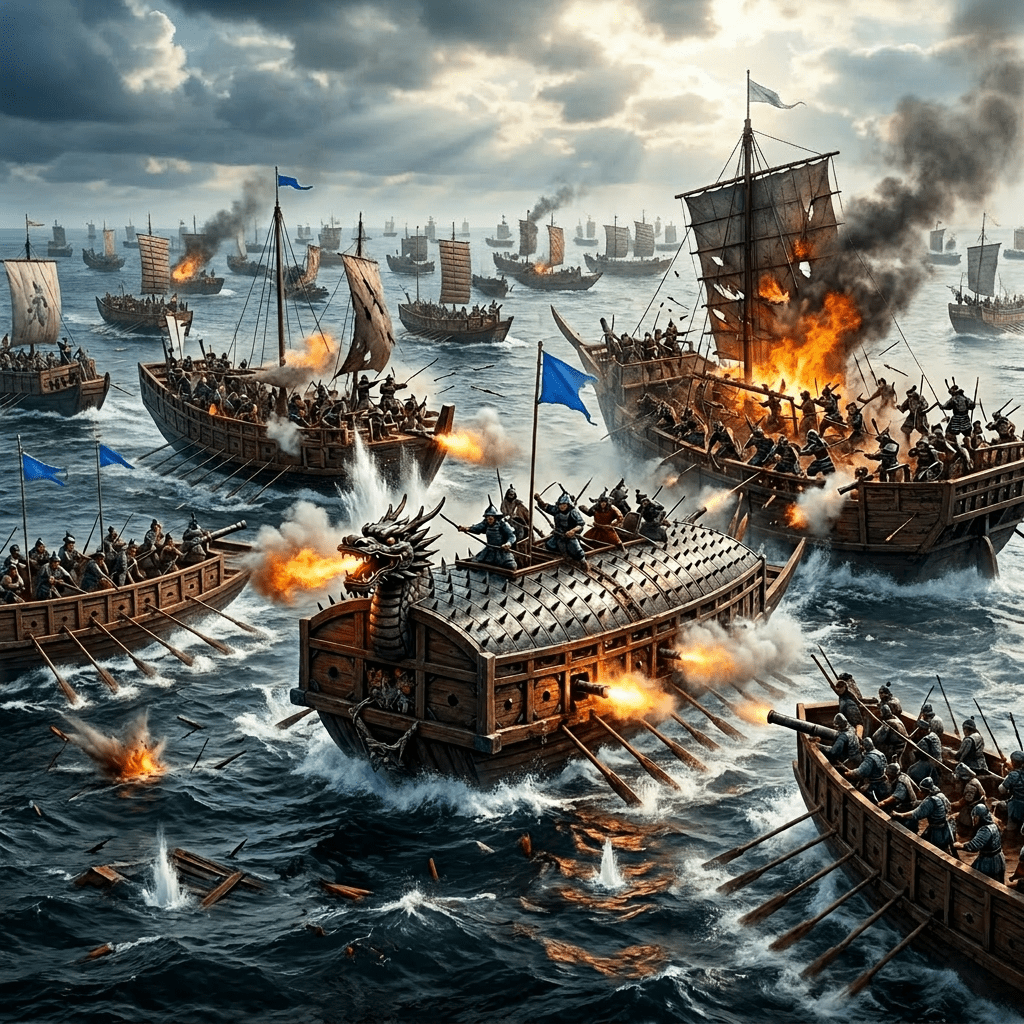
The Admiral fought with Turtle Ships. Some enthusiasts refer to them as the Battleships of the day. In the Battle of Hansando (한산도 해전) the Admiral baited the enemy ships into open waters, trapped them in a Crane Wing Formation and reduced the enemy fleet to complete ruination. In another battle, the Battle of Myeongnyang (명량해전) the Joseon Navy destroyed over 100 enemy ships by leading them to a treacherous strait causing the ships to collide with each and attacking them, with only thirteen (13) ships in their own fleet. As I read of these battles on the tablets I found myself being pulled into the place, not merely Gwanghwamun, but as if a sailor on the Admiral’s ship, a sense of bravery flowed through my veins.
I was not alone in that. As I moved onto the tablets on the other side, three young boys were engaged in spontaneous role play, with one of them saying, “Your Majesty, we still have 12 ships, we can still win.” The boys were re-enacting an inscription. The inscription read;
“지금 신에게는 아직 12척의 배가 있습니다. 죽을힘들 다해 막아 싸우면 반드시 할 수 있습니다.”
The King had given an order to disband the navy, but Admiral Yi Sun-sin courageously responded saying they still had 12 ships and could win if they fought hard. True to his words, they won the next battle (Battle of Myeongnyang) with only 13 ships. There were many tourists both local and foreign, all of us witnessed the same elements that day. Yet, many just passed by barely stopping to read the inscriptions. Many others were engrossed in taking clicking pictures, one after the other in different angles. On any other day I would have been one of the many. But that day I was completely immersed in the experience the square offered. The three boys may have been device free unintentionally, however the result was no different, they too were immersed and embracing the courage that the Admiral himself displayed.
The story of the Admiral, as told at the Gwanghwamun Square takes you on a journey. It displays the Admiral’s courage and resilience one battle after the other. If those battles were his achievements on a resume, it need not continue. However the story continues. His integrity was the next chapter. One inscription demonstrated how the Admiral refused to meet with members of his clan because he was in a position of power. The Admiral didn’t rely on his accomplishments, instead he made genuine efforts to maintain his integrity. By this point I was really impressed by the Admiral. In my mind I was painting a picture of the Admiral as unshakable.
A few moments later however, I felt a breaking. An inscription read;
“슬프다. 내 아들아! 나를 버리고 어디로 갔느냐?”
Those words written in the Admiral’s war diary, instantly painted another picture. An Admiral, reading a letter that brought the news of his son’s death, dropping to his knees, wailing and crying out to his son, ‘where have you gone abandoning me?’ The words carry the weight of the Admiral’s grief. His pain transferred on to me in that moment, bringing me to tears.
As I lifted my gaze to the Admiral’s sculpture, gone was the image of strength while sorrow filled his face. The same man, who instilled fear in his enemies, who brought out the courage in his sailors, had become so broken as well.
On a bus ride that day, I looked back on my trip to Yeosu in the previous year. There too was a sculpture of Admiral Yi Sun-sin and information about the Admiral’s feats. But after that trip I couldn’t correctly recall the Admiral’s name, and I knew nothing about the Admiral’s battles. I was only left with mere photographs of the sculpture, information boards and the replica of a Turtle Ship. Yet, after my visit to Gwanghwamun Square the Admiral’s story now remains in my memory, not as mere knowledge of his endeavours, but with profound admiration.






Leave a Reply