Growing up my family had a black and tan Dachshund named Mindy. Her world revolved around food. She would carry her little plate by her teeth and bring it to guests, if any food was served to the guests. She would lay down below the rack which held the loaf of bread and growl at all other pets who walked past, even if they showed no interest in the bread. She ate anything and everything without second thought, and one day she ate a Nai Miris (a Sri Lankan chili with intense heat) and saw stars. It goes without saying that Mindy was a big part of our family’s entertainment, and when in grade 3 of school an activity involved drawing an animal, I drew Mindy. My drawing was so bad that a friend made fun of it for only having two legs. I was a big cry baby back then and I cried over that too. In hindsight, it was really funny because in fact I had only drawn two legs. It was my version of a 2D side view of Mindy standing straight. The point of this story for the purposes of this post is that I am not a good artist.
Fast forward two decades now we live in the age of artificial intelligence (AI), in an age where creativity is at our finger tips. Research studies prove that AI has increased our individual creativity, which means that I no longer have to grab my chalk and paper, draw a two legged dog and get laughed at (although I still enjoy the occasional ridiculous drawing and laughing at myself). I can now simply enter a prompt into an AI Chatbot like ChatGPT and Gemini to create the image. A few months ago, I wanted to show a friend the cat of my dreams—and I mean that quite literally: a cat I saw in an actual dream, covered in Dalmatian spots. Instead of a crappy drawing, a simple prompt on Gemini created this Dalmatian-cat image. There is no way I could have made such an image with my drawing skills – but with AI it is possible.
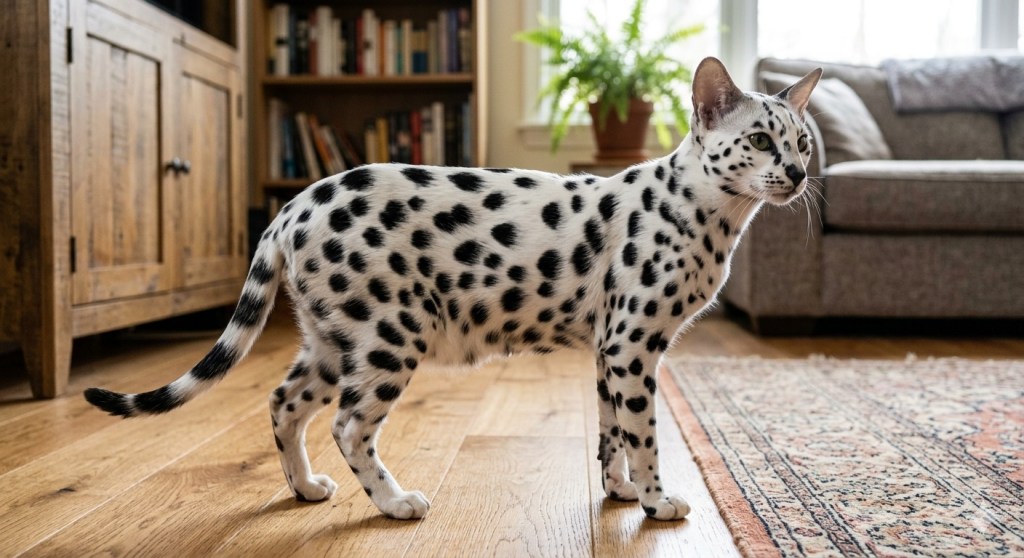
(Image created using Gemini)
Research also tells us that AI reduces collective creativity. In recent months, Generative AI has been particularly useful to me in designing visuals for marketing strategies in the course of my MBA. From food menus and sales promotions to restaurant layouts, logos, and advertisements—with the right prompt, everything was easy to create and visually appealing. However, the point about collective creativity became obvious when my colleagues presented their teams’ marketing strategies. Even if the marketing strategies themselves were different and creative, the designs of presentation visuals were similar. Similarities were so obvious that my teammate and I played a game of ‘Guess the AI’, as we watched the presentations. If we look around us, we could find more similarities in designs. For instance, two new food outlets in close proximity to my home have similar looking red background white lettering name boards, begging the question whether they were created using AI.
These observations simply confirm what research studies have proven. Although AI increases individual creativity, like how I can create an image of a dog when I cannot draw to save my life, collective creativity reduces – everything starts to look similar. This is not confined to image creation, but also to writing and other forms of creativity.
Despite this reality, I like to think that it doesn’t spell doom for real human creativity. When the idea is born in the human mind, it stands out among a sea of AI-borne ideas. There is a certain premium attached to it. Perhaps like how anything with a handmade tag is valued higher than its machine-made counterparts. Of course we may not be able to completely eliminate AI from our creative pursuits, but we can make it our subject, ensuring that it doesn’t decommission our brains. In this way, real human creativity is likely to become a niche.


Leave a Reply