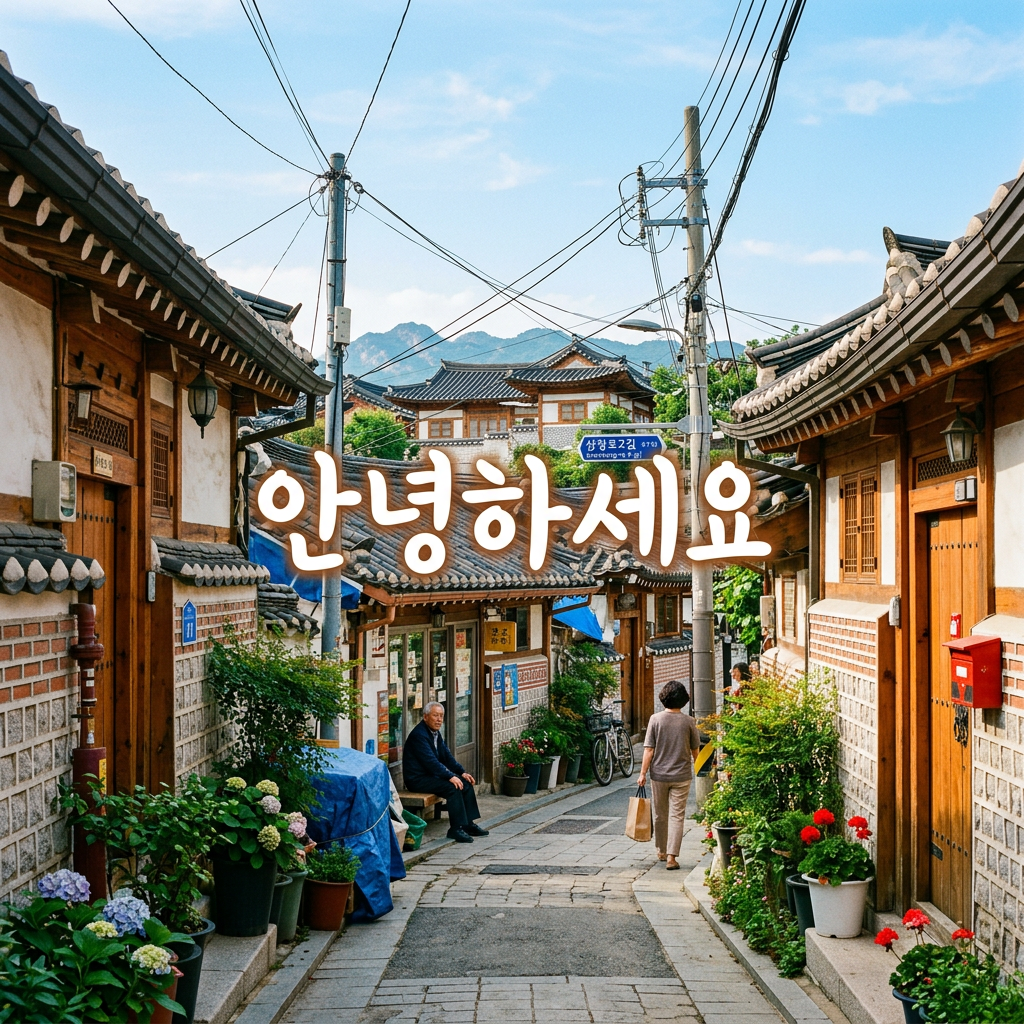
The experiment of unmediated pleasures was largely a success. Its consequences were the keen observational skills, sharpened memory and the immersive experiences. The morning at Gwanghwamun and the Sway at the Isaac Hong concert serve as ample evidence. The experiment however, yielded another unintended result; increased human interaction through the Korean greeting annyeonghaseyo (안녕하세요). In my experience, this simple greeting is integral to life in Korea. What follows below is an exposition of the transformative power of the annyeonghaseyo based on my experience.
The story begins with my morning at Gwanghwamun Plaza. An information board described the historical significance of the plaza, but not that alone. As if obiter, the same board informed of the security implemented at the plaza for its protection. In the next moment as I turned my attention to the plaza itself, it wasn’t the towering statues of Admiral Yi Sun-sin or King Sejong the Great that caught my attention. It was the police officers standing guard, each at their individual designated positions.
People passed-by these part teal part black attired officers, walking around them like we do the trees planted on pavements. All of them wore black full-face masks and blackout sunglasses to protect themselves from the blazing sun. From afar it appeared as though these officers themselves had become relics of the historic site.
Not long after I too was to become one of the many passers-by. However, not wanting to relegate the officers to relics, I offered a bow and an annyeonghaseyo to the first officer I met in my way. As if reanimated he shuffled in place, bowed his head and returned the greeting. I imagined that he carried an expression of weariness brought on by the scorching sun. I could only imagine because his face was completely covered. I hoped that the simple exchange of the annyeonghaseyo would ease that weariness. Moments later, as I glanced behind me for a reason I cannot now recall, I realised it had done something more: the officer’s face was no longer covered. He had peeled off his mask and sunglasses. I thought to myself that maybe it was the greeting and that simple human interaction, which made him do so. And that maybe if I had been engrossed in my phone, I wouldn’t have ever felt the need for this interaction.
Annyeonghaseyo itself means, ‘are you in peace?’ And it didn’t take long for me to realise that it is more than just a ‘hello’, more than a simple greeting. Here in Korea, even when you walk into a store, even if it is just a convenience store, the greeting flows out of you. You could say it to a stranger as you walk past them, even if that is all you ever say. Short it maybe, but it amounts to a meaningful conversation and the making of another human connection.
I have a good friend here in Korea. She is a little ditzy, a big fan of Phoebe from Friends, a regular gym-goer, and deeply insightful—she is Shiksha. We have the best Friday nights, sitting outside the neighbourhood CU, sometimes just sipping water, talking important things, and people watching. One thing we don’t do is give attention to our phones; in fact, on most Fridays, we leave them behind at home.
As we people watch, we sometimes say annyeonghaseyo to passers-by. Not to every passer-by. We are by no means extroverts so it takes great effort to greet strangers. Sometimes these strangers greet us first. And that’s all we do.
One Wednesday night as we were returning home from a class, we bumped into one of the ladies with whom we had exchanged greetings outside the CU. Previously, it had been just a fleeting greeting. But that night, outside of our usual spot, the familiarity born from those past exchanges blossomed. We ended up talking about school, our home countries, and even petting her cuddly dog. We had formed a connection, and it all began with being immersed in the moment and taking an effort to build human connections. If you are a person living in a foreign land away from the familiarity of your homeland, these human connections brief though they maybe, are worth more than gold. This has been my experience.
Concluding remarks about unmediated pleasures
Unlike during my short three-day experiment, the complete elimination of technology is difficult in the present age. However, we can all take some meaningful steps toward reducing technology use. These measures may be as simple as keeping our smartphones in our bags while commuting or leaving the phone behind during daily walks. It could even mean resisting the urge to look down at the phone in the minute or two we stand at a pedestrian crossing. For me, the measures also include using app timers – 5 minutes each for Instagram and Facebook – and making my bed a no-phone zone. These little changes have made a huge difference. The honed observational skills, sharp memory, immersive experiences and even the increased human interactions, have all made life feel more meaningful and well worth the effort.





Leave a Reply